To quickly level ground for a new storage shed, choose a foundation type like a gravel pad, concrete block and timber frame, or plastic grid system, then follow a systematic process of site preparation, rough leveling, weed barrier installation, and precise foundation setup. This approach ensures a stable, durable base efficiently, preventing structural issues and premature deterioration. For example, a gravel pad can be installed relatively quickly because gravel is easy to spread, level, and compact.
This comprehensive guide walks you through fast and effective methods for leveling the ground, from choosing the right foundation type to a step-by-step installation process, complete with expert tips for speed and durability.
Choosing the Right Foundation for Speed and Stability
When time is of the essence, selecting the appropriate foundation type can significantly impact the speed and ease of your ground leveling project. Different foundations suit various ground conditions and shed sizes, offering distinct advantages for a quick setup.
Gravel Pad Base A gravel pad foundation involves excavating an area, lining it with a weed barrier, and then filling it with compacted gravel or crushed stone. This method is a favorite for its versatility and drainage properties. It’s relatively quick to install because gravel is easy to spread and level, and adjustments can be made without extensive effort. Gravel pads are excellent for most shed types on slightly uneven ground, providing a stable, well-draining base that keeps moisture away from your shed’s floor. While it does require some excavation and hauling of material, the speed of leveling and compaction often makes it a preferred choice for a quick setup.
Concrete Block and Timber Frame Base For yards with more significant slopes or for larger, heavier sheds, a concrete block and timber frame base offers a fast and robust solution. This method involves strategically placing concrete blocks on prepared spots, often with a gravel sub-base, and then laying a pressure-treated timber frame on top. This approach is faster than pouring a full concrete slab, as it eliminates curing time and extensive concrete work. It’s particularly effective on uneven terrain because individual blocks can be leveled independently, providing a stable, elevated platform that promotes excellent air circulation underneath the shed, reducing moisture issues.
Plastic Grid Systems Plastic grid systems are an increasingly popular option for their exceptional ease and speed of installation, especially for lighter-duty sheds or on ground that is already relatively level. These interlocking grids are placed directly on a prepared, leveled surface (often with a weed barrier) and then filled with pea gravel or crushed stone. The installation process is straightforward: snap the grids together, lay them down, fill, and lightly compact. They offer good drainage and are lightweight, making them ideal for DIY enthusiasts looking for a very fast foundation without heavy lifting or complex leveling tasks. However, they may require more extensive ground preparation if the site is significantly uneven.
Essential Tools and Materials for Fast Leveling
|
Our Picks for the Best Storage Shed in 2026
As an Amazon Associate I earn from qualifying purchases.
|
||
| Num | Product | Action |
|---|---|---|
| 1 | Housolution Bike Storage Tent Shed for 5 Bikes, Outdoor Portable 210D Oxford Thick PU4000 Waterproof Bike Cover with Ventilated Window, Bike Tent Fit for Bicycle, Lawn Mower, Garden Tools |

|
| 2 | Bike Storage Shed Tent, Outdoor Bicycle Storage Shed, Waterproof Portable Bike Covers Shelter, 7.2x4.9x6.1ft Large Garage Tent for Motorcycle, Garden Tools, Lawn Mower |
|
| 3 | Bike Storage Shed Tent,Bike Cover Waterproof Outdoor Storage Shed with 30% More Top Storage Space for 4-5Bikes,Portable Bicycle Shelter for Motorcycle,Garden Tools,Lawn Mower |
|
| 4 | Bike Tent, 81 * 39 * 65 in Outdoor Portable Storage Sheds, 210D Oxford Thick Waterproof Fabric,PU4000 Waterproof for 2/3/4 Bikes,Bike Covers for Motorcycle,Garden Tools,Lawn Mower |
|
| 5 | Happy Travel Bike Storage Tent Shed, Outdoor Waterproof Bicycle Covers Shelter with Window for 2/4/6/8 Bikes,Oversized Outside Portable Sheds for Lawn Mower,Garden Tools (Black) |
|
| 6 | Happy Travel Bike Storage Tent Shed, Outdoor Waterproof Bicycle Covers Shelter with Window for 2/3/4/6/8 Bikes,Oversized Outside Portable Sheds for Lawn Mower,Garden Tools |
|
| 7 | 39.4" Larger Storage Shed Tent for Bike Motorcycle ebike eScooter Lawn Mower Outdoor Canopy Shelter Protection with Water Resistant Dustproof Windproof and Sunproof for RV Travel |
|
| 8 | Happy Travel Bike Storage Tent, Outdoor 8×7×6.3ft Large 2-in-1 Portable Shed More 30% Top Space W/Double Doors with Mesh, Outside Lawn Mower Shelter and Bicycle Cover for Patio Furniture, Garden Tools |
|
| 9 | Happy Travel Bike Storage Shed Tent,Outdoor Portable Bicycle Storage Sheds with 210D Oxford Fabric PU4000 Waterproof for 2/3/4/6/8 Bikes,Bike Covers Shelter for Motorcycle,Garden Tools,Toys,Lawn Mower |
|
| 10 | Bike Storage Tent,for 2-10 Bikes, 118 x 86 x 72 in Outdoor Portable Bike Storage, 210D Oxford Fabric PU4000 Waterproof, 2 Rolling Doors, for Motorcycles or Large Motorcycles, Without Floor |
|
Having the right tools and materials on hand is crucial for completing your ground leveling project quickly and efficiently. Gathering these items before you begin will prevent delays and streamline the process.
Tools You’ll Need:
- Shovel and Rake: For digging, spreading, and rough leveling.
- Wheelbarrow: To transport soil, gravel, and other materials.
- Stakes and String: To accurately mark the shed’s footprint and guide your leveling efforts.
- Tape Measure: For precise measurements and ensuring squareness.
- Spirit Level (long plank recommended): A 4-foot or longer level placed on a straight board is essential for checking and achieving accurate levelness across the entire area.
- Ground Tamper or Plate Compactor: To compact soil and gravel, creating a firm and stable base. A plate compactor (rentable) significantly speeds up this step.
- Utility Knife: For cutting weed barrier fabric.
- Rubber Mallet or Hammer: For gently adjusting concrete blocks or pavers.
Materials for Your Base:
- Gravel/Crushed Stone: For gravel pads or as a sub-base for blocks. 3/4-inch crushed stone or pea gravel are common choices for good drainage and compaction.
- Sand (Optional): Can be used as a thin leveling layer under pavers or concrete blocks.
- Weed Barrier/Landscape Fabric: To prevent weed growth through your foundation.
- Concrete Blocks: If opting for a block and timber frame foundation.
- Pressure-Treated Timber: For the base frame if using concrete blocks (e.g., 4x4s or 6x6s).
- Shims (Optional): Composite shims can be useful for minor adjustments under timber.
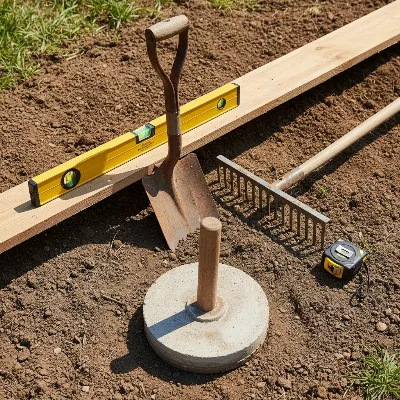 Essential tools for fast ground leveling for a new storage shed foundation
Step-by-Step Guide: Fast Ground Leveling for Your Shed
Achieving a perfectly level base quickly involves a systematic approach. Follow these steps to ensure a stable and durable foundation for your new storage shed.
-
Site Selection and Initial Preparation: Begin by choosing a location that is naturally as level as possible, well-drained, and free from standing water. Clear the designated area of any existing grass, rocks, roots, or debris. For optimal drainage and splash protection, mark out the shed’s footprint using stakes and string, extending the perimeter an additional 6 to 12 inches beyond the shed’s actual dimensions. Confirm the squareness of your layout by measuring the diagonals; they should be equal.
-
Rough Leveling (Digging and Filling): Identify the highest point within your marked area using your string lines and a spirit level. This highest point will serve as your reference for the entire base. Begin digging down any high spots to create a relatively flat surface. For a gravel pad, aim for a consistent depth of about 4-6 inches across the entire area. For low spots, fill them with compacted soil or gravel, ensuring they are firm and stable. The goal here is to get the ground as close to level as possible before introducing your foundation materials.
-
Install Weed Barrier: Once the rough leveling is complete, lay down a layer of landscape fabric or weed barrier across the entire prepared area. Overlap the edges by at least 6-12 inches to prevent weeds from growing through your shed’s foundation. This simple step saves significant maintenance time in the future.
-
Choose Your Fast Foundation Method and Install:
Method A: Gravel Pad (Quick & Versatile) If you’ve chosen a gravel pad, start by filling the excavated area with 4-6 inches of your chosen gravel or crushed stone (e.g., 3/4-inch or pea gravel). Spread the gravel evenly with a rake. Then, compact it thoroughly using a ground tamper or a rented plate compactor. Compaction is critical for stability and preventing settling. Regularly check for levelness using a long spirit level placed on a straight board. Add or remove gravel as needed, compacting and checking until the entire surface is perfectly level.
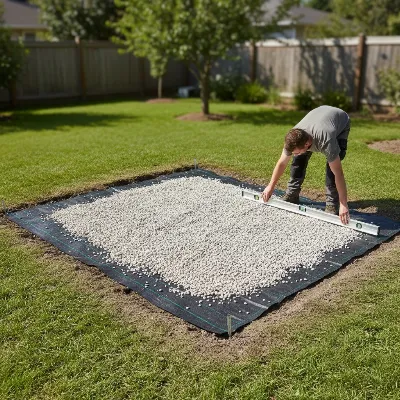 Gravel pad foundation for a quick shed base installation
Method B: Concrete Blocks with Timber Frame (Fast for Slopes) For a concrete block base, mark the precise locations where each concrete block will sit—typically at the corners and at regular intervals along where the shed’s timber frame will rest. Dig shallow depressions for each block, roughly 2 inches wider than the block, and fill with 1-2 inches of compacted pea gravel. Place each concrete block into its depression. Using a spirit level on a long, straight piece of timber (like a 2×4 or 4×4), level each block individually, and then in relation to the others. Adjust the height by adding or removing gravel underneath the blocks, or by using composite shims if only minor corrections are needed. Once all blocks are perfectly level and aligned, place your pressure-treated timber frame on top and secure it.
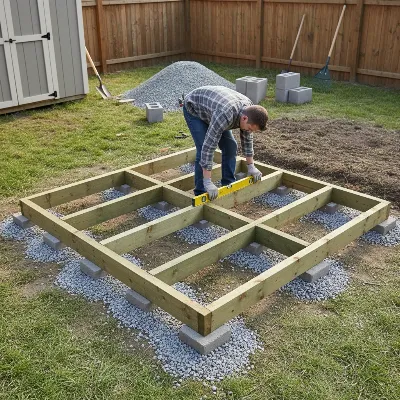 Building a concrete block and timber frame shed base on uneven ground
Method C: Plastic Grid System (Easiest on Level Ground) If you’re using a plastic grid system on mostly level ground, ensure the area is well-compacted and the weed barrier is in place. Lay out the interlocking plastic grids according to the manufacturer’s instructions, snapping them together to form the shed’s footprint. Once the grids are in place, fill them with pea gravel or crushed stone and lightly compact. Check the entire grid system with a long spirit level to ensure it’s uniformly level, making any necessary minor adjustments to the underlying ground or gravel.
Advanced Tips for a Quicker, Stronger Base
To further enhance the speed and durability of your shed base, consider these expert recommendations:
- Start with the Highest Point: Always begin your rough leveling by identifying the highest point in your marked area and digging down from there. This minimizes the amount of fill material needed and can significantly reduce your workload and material costs.
- Utilize a Laser Level: For larger shed footprints or sites with noticeable slopes, investing in or renting a laser level can drastically improve accuracy and speed. A laser level provides a consistent, visible reference line, making it much easier to level your ground or individual blocks quickly and precisely.
- Rent a Plate Compactor: While a hand tamper works, a motorized plate compactor will compact your soil and gravel much more thoroughly and in a fraction of the time. This is especially beneficial for larger pads, ensuring a denser, more stable base that resists settling.
- Ensure Proper Drainage: Beyond just leveling, consider the overall drainage of your site. Sloping the ground slightly away from the shed’s perimeter (e.g., 1/4 inch per foot) can help shed rainwater effectively, preventing water from pooling around the foundation.
- Use Pressure-Treated Materials: Any timber used in contact with the ground or as part of your foundation frame must be pressure-treated to resist rot and insect infestation, ensuring the longevity of your shed’s base.
Creative Uses for Your Leveled Shed Space
Once your shed is built on its perfectly leveled foundation, the possibilities extend far beyond simple storage. A stable, dry base opens the door to transforming your shed into a truly functional and enjoyable space. Consider converting it into a dedicated workshop for your hobbies, a quiet home office or study away from household distractions, a compact home gym, or even a cozy garden retreat where you can relax and unwind. The solid foundation you’ve built allows for confident customization and furnishing, making your shed a valuable extension of your home.
Conclusion
Creating a level and stable foundation is the cornerstone of any successful storage shed project. While it might seem like an extra step, proper ground preparation ensures the structural integrity, longevity, and functionality of your shed, preventing costly issues down the line. By choosing an appropriate foundation method—be it a gravel pad, concrete block and timber frame, or a plastic grid system—and following the detailed steps for efficient leveling, you can quickly achieve a robust base. Embracing practical tips, like starting from the highest point and utilizing proper compaction tools, will further streamline your efforts, allowing you to move from preparation to construction swiftly and confidently. With a perfectly leveled foundation, your new storage shed will not only stand strong against the elements but also open up a world of possibilities for its use.
Now that you know how to lay a fast and stable foundation, what will your perfectly leveled shed become?
Frequently Asked Questions
How to Quickly Level Ground for Your Storage Shed
Follow these steps to efficiently level the ground and install a stable foundation for your new storage shed, ensuring its longevity and functionality.
Choose a naturally level, well-drained location. Clear grass, rocks, and debris. Mark the shed's footprint with stakes and string, extending 6-12 inches beyond the shed dimensions, and ensure squareness by checking diagonal measurements.
Identify the highest point in your marked area using string lines and a spirit level. Dig down high spots to create a relatively flat surface. For a gravel pad, aim for a consistent depth of 4-6 inches, filling low spots with compacted soil or gravel.
Once rough leveling is complete, lay landscape fabric or a weed barrier across the entire prepared area. Overlap edges by at least 6-12 inches to prevent weed growth through the foundation, saving future maintenance time.
For a gravel pad, fill the excavated area with 4-6 inches of gravel, spread evenly, and compact thoroughly with a tamper or plate compactor, checking for levelness. For concrete blocks, mark block locations, dig shallow depressions, fill with 1-2 inches of pea gravel, place blocks, and level individually and collectively before adding a timber frame. For plastic grids, lay interlocking grids on a compacted surface, fill with gravel, and lightly compact, ensuring uniform levelness.

I was dreading the whole process of getting my new shed set up, especially leveling the ground. The gravel pad method mentioned here was a lifesaver! It was surprisingly straightforward to spread and compact, and my shed feels incredibly stable. Definitely recommend this approach for anyone short on time.
This guide saved me so much hassle! I followed the systematic process for site preparation and it made all the difference. My new garden shed is sitting perfectly level, and I feel confident it will last for years. The expert tips for durability were spot on.
The plastic grid system was a new idea for me, and I’m glad I gave it a shot. It really did make the rough leveling much easier, and the weed barrier installation step was crucial. My shed is on a slight slope, and this foundation type adapted well. Good advice for preventing future structural issues.
I tried the concrete block and timber frame method for my shed. While it eventually worked, getting the blocks perfectly level took a lot more fiddling than I expected. The guide was helpful, but I wish there were more tips on how to quickly adjust those stubborn blocks without having to restart. It’s solid now, but it wasn’t as ‘fast’ as I hoped.